
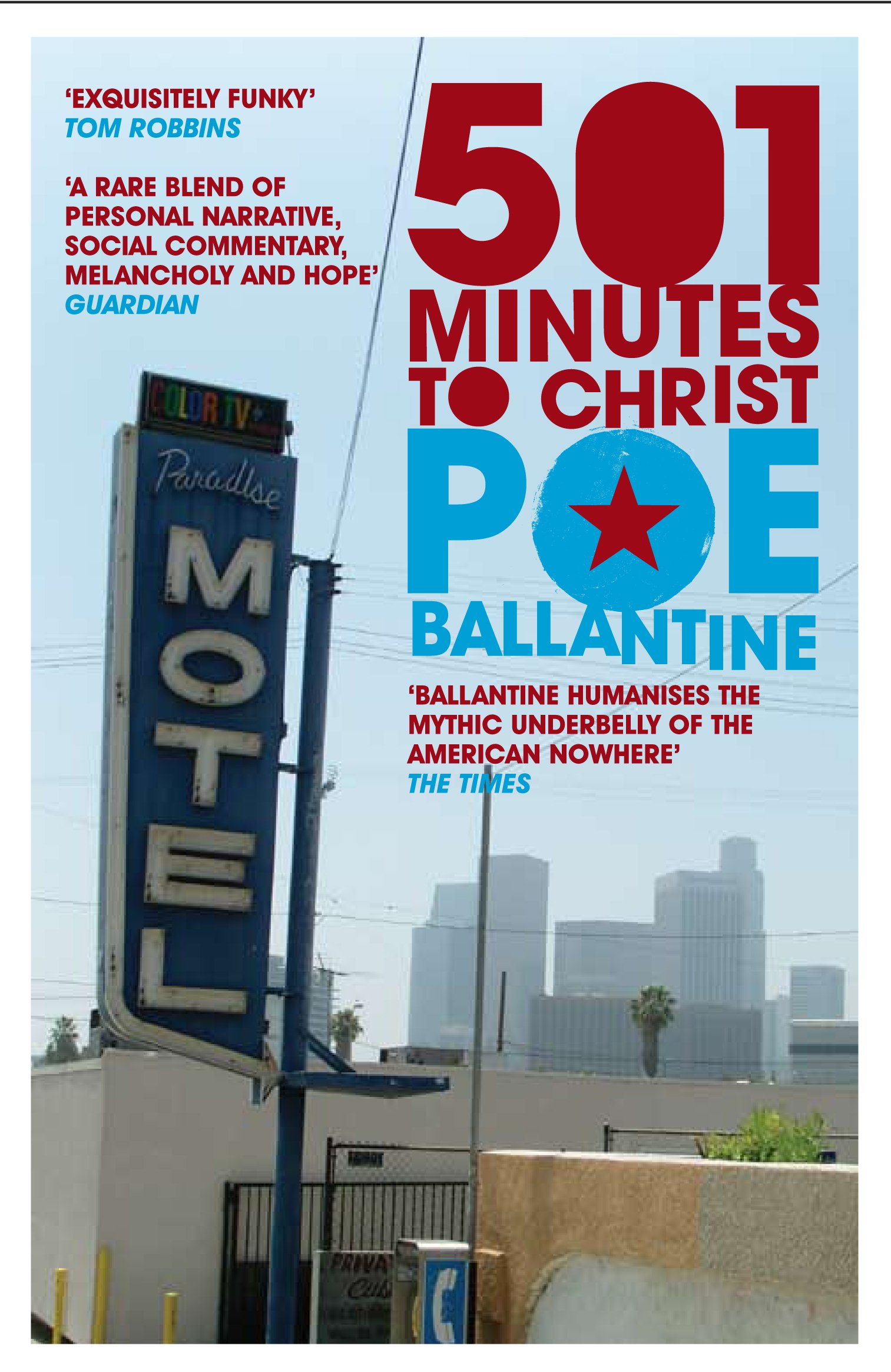
Poe Ballantine: 501 Minutes to Chris. More Tales of an American Drifter. Old Street Publishing, London, 2007.
Otro magnífico libro de relatos de Poe Ballantine (Denver, 1955) no traducido al castellano. Es una continuación de Things I Like About America.
En World of Trouble el narrador habla de su paso casual por Nueva Orleans: trabajos con sueldos miserables y una lluvia impenitente. Mientras no reúna suficiente dinero para el autobús está atrapado en la ciudad del Katrina. No puede siquiera dormir en la calle porque la costumbre local es apuñalar a los sin-techo. Así que no le queda otra que darse grandes paseos nocturnos para afrontar al día siguiente más lluvia y una jornada extenuante. En estas condiciones la felicidad es un asunto muy sencillo: un plato de espaguetis con salchichas.
My Pink Tombstone es un maldito sobre de color rosa que encierra muerte, decepción y un barco que nunca zarpa.
Methamphetamine for dummies es un espléndido relato dónde la metanfetamina se convierte en una especie de renovado Mefistófeles. Cumple todos tus deseos pero devora sin piedad tu alma. Cito dos textos típicos del estilo de Ballantine: realidades complejas se muestran de un modo directo, con ironía y sarcasmo.
Overall the effect of this inhaled form of industrial-strenght speed is Pentecostal Church Meets Hercules at the Beach. There’s a feeling like love, galactic in its proportions, blend in fulfillment, well-being, and above all potency, the sense that if you wanted to you could do anything: finish a novel, write a symphony, spin the couch with two people on it like a basketball on your figertip, wallpaper the living room, find a girl, settle down and have a familyu, drive on up to Canada and sell all the belts you just tooled, anything, it’s just you choose instead to stay here and talk with these wonderful people who share your dreams, who are lovin and optimistic as you becuse afeter all they are your family. (p. 54)
God strike me with a urine-soaked newpaper if I ever do this drug again, the aftermeth is simply unforgiving, a hangover infinitely more excruciating than alcohol, as if your nerves have been shaved by an asthmatic witch doctor, pumped with mustard gas, and then stomped crookedly by a drunken plumber who refuses to scrape his boots. Unlike coke or heroin, there is nothing subtle or romantic about this souped-up bath tub solvent concocted from the very items I move daily at the chemical warehouse. I’m convinced that methamphetamine is not a drug but a plague, which I believe Nature, in order to keep her mortal quota, has supplied in lieu of yellow fever and cholera. (p. 57)
El ambiente descrito por Ballantine es el propio de la serie de televisión Breaking Bad (Gilligan, 2008).
Conspiracy and Apocalypse at the Mcdonald’s in Goodland, Kansas, da un repaso a los interminables viajes del narrador por Estados Unidos. Curiosa es la forma en que elige sus destinos:
The town had looked like a miserable place where people wouldn’t want to go, which is the criterion I have used to pick my travel destinations for the last ten years. I have been to all the places where people wnat to go, and those are the worst places to live: they are crowded, the rent and the crime is high, the competition for pastries is fierce, and there is often a rude or exclusive attitude. In places no one wants to go, the rent is cheap, the people are happy to see a stranger (what are you doing here?), and it’s usually pretty easy to get a job -so it’s upside-down logic, but not really. (pp. 69-70)
Sin embargo, no siempre es fácil dar con sitios así. De decepción en decepción el protagonista relata los largos trayectos en autobús y las conversaciones que escucha a su alrededor. Uno de ellas es especialmente interesante. Cuando un mormón paranoico le habla del plan urdido por Dios para el fin del mundo Ballantine arguye filosóficamente:
Because things go up and things go down. That’s what I ended up saying to the Mormon in Goodland after he’d rattled off his conspiracy-and-apocalypse number on me. He said his vision of conspiracy and apocalypse was grounded in the Word, but I said even God couldn’t think up a plot that complicated. Sometimes it takes the wisdom of a potbellied epicurean truck driver to bring us back to reality. Things go up and things go down. It isn’t much more complicated than that. The trip will be over soon enough. Don’t be afraid to try the next town. You don’t ever really want it to end, anyway. (p. 88)
Advice to William somebody es, antes que un relato, un ensayo sobre la depresión y el suicidio en una sociedad enferma y fármaco-dependiente. Ballantine admite que es uno de tantos en el mundo desarrollado aquejado de esa plaga endógena e incurable que llamamos depresión. Parafraseando a Stuart-Mill la libertad individual en Estados Unidos termina allí donde empiezan a ofrecerte venenos, fármacos, drogas o como quiera llamárselos.
Widespread clinical chronic «endogenous» depression, however, is recent, coincidental with either music videos or the development of new anti-depressant wonder drugs and the armies of manufacturersand professionals eager to recommend and administer them. Americans are a stubbornly independent lot, descendants of pirates, puritans, smugglers, and tax evaders, but we are surprisingly compliant when it comes to the offer of drugs. (p. 92)
¿Cómo resistir a la tentación del suicidio? Ballantine no tiene una respuesta concreta pero sí mucho sentido del humor.
The fact that I am still alive amazes me every morning. I wish I had a psychological formula, a rescue kit to hand out to my fellow melancholies. I wish I could say: This is what saved me. But each time it’s something different: Kindness from a stranger. Lack of courage. Obligation to parents. Inability to write a good note. The possibility that I will have to start over again as a one-legged beggar in Tijuana or a housefly hatching out of a Dairy Queen swirl of yellow poodle doo-doo. Or I’ll imagine the appearance of my corpse, its state of decomposition by the time I am found, which always reminds me of the footage of the Jonestown mass suicides and how silly these people looked, all swollen in polyester heaps and black at the fingertips—the ultimate in bad fashion. (pp. 95-96)
501 Minutes to Christ gira en torno a la sensibilidad mística, informal y heterodoxa, de Ballantine. Dos ideas me han llamado la atención. En primer lugar, una curiosa observación sobre la televisión:
Without the distraction of television, that life-support system for people with no lives, I sit for a long while, steeping in the sudden revelation of my own stagnancy. ( p. 103)
En segundo lugar, dos experiencias místicas explicadas con absoluta sencillez:
I’ve seen Christ twice in my life: once while stoned and all alone in a flea-ridden Mission Beach bungalow; the other time, not long ago, while praying out of the depths of my despair. On both occasions the darkness parted, and my heart was lifted with awe. (p. 117)
En God’s Day narra cómo pasa su peculiar ramadán: un día al año el autor ni come, ni habla, ni trabaja, ni fuma, ni lee, ni ve televisión ni amigos. Simplemente contempla, reza y se esfuerza por echar una mano a alguien. En este caso a un «hobo» llamado «Dirty Man».
Realism explica por qué se pasa la vida huyendo de sí mismo, dando tumbos de un lado a otro, «an American drifter». A partir de una metáfora de Vonnegut, una de sus influencias literarias, Ballantine da una explicación muy realista.
I once read an interview with Kurt Vonnegut in which he talked of his disenchantment with scientific truth because «we dropped [it] on Hiroshima». Vonnegut’s metaphor is apt: The truth is no flickering Hawaiian lantern. It is searing white light. It scorches roaches and saints alike. (p. 135)
Realism is brutal, and the truth is a killer that none of us want to face. ( p. 143)
Blessed Meadows for Minor Poets es un ajuste de cuentas con la gran industria editorial. Después de meses de trabajo con una editora sin criterio rompe el contrato de su vida y vuelve a la carretera.
Wide-Eyed in the Gaudy Shop parece estrictamente autobiográfico: la historia de su matrimonio con una joven mejicana.
En The Irving da cuenta de su primera lectura multitudinaria. Alaba a Bukowski pero cuestiona a Norman Mailer y John Irving. Para salvar a la literatura de estos recitales televisados, de la transformación de la literatura en mercancía, planea dejar K.O. a Irving de un puñetazo al igual que, según cuenta la leyenda, hizo Norman Mailer con Gore Vidal.
Muy recomendable.
 Aula de Filosofía de Eugenio Sánchez Bravo.